
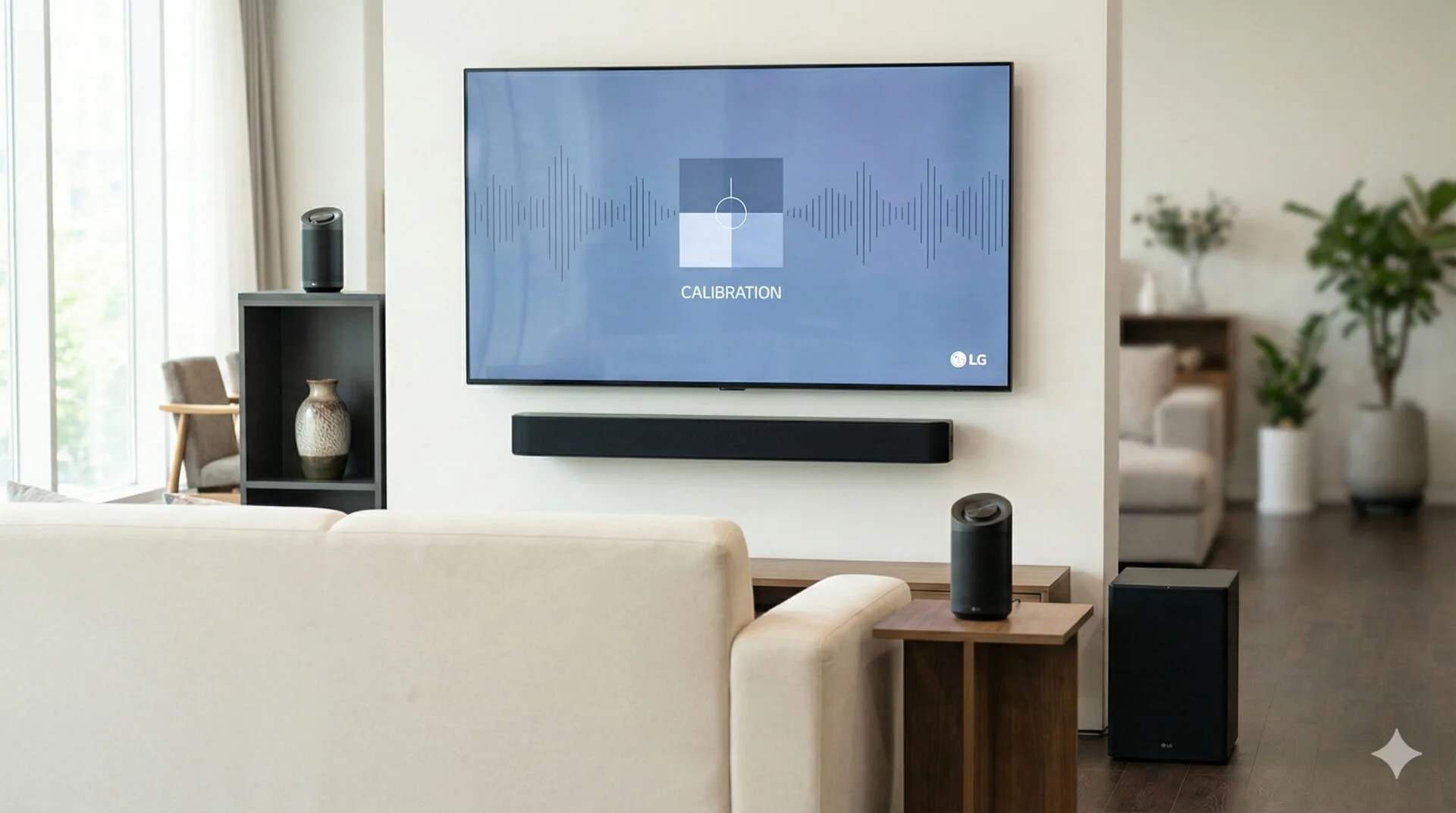

LG is getting an early start on the CES season. Ahead of CES 2026 (which begins January 6), the company has announced Sound Suite, a new modular home entertainment audio lineup built around a flagship soundbar and optional add-on speakers.
The attention-grabber is that LG’s top bar in the range—the H7 soundbar—is the first soundbar to incorporate Dolby Atmos FlexConnect, a new Dolby technology designed to make immersive audio less dependent on “perfect” speaker placement. If the claims hold up, the result could be a meaningful shift for living rooms that aren’t symmetrical, aren’t dedicated theaters, or simply can’t accommodate traditional surround layouts.
LG hasn’t shared pricing, ship dates, or full technical specifications yet, but it has outlined the system components, the intended upgrade path, and the core technologies that will define the platform.
What LG announced: Sound Suite, a modular Atmos system
LG’s Sound Suite is positioned as a build-as-you-go home theater ecosystem. Rather than selling only fixed “home theater in a box” bundles, LG says each component can be purchased separately—allowing buyers to start with a soundbar and expand over time.
The Sound Suite lineup includes:
- H7 soundbar (the centerpiece)
- M7 surround speakers
- M5 surround speakers
- W7 subwoofer
LG’s messaging emphasizes that the system is modular, similar in concept to how premium soundbar ecosystems let you add surrounds and a subwoofer later. (For example, Sonos has long leaned on this approach.)
If you outfit a room with the full Sound Suite lineup, LG says it can scale up to a 13.1.7-channel home theater configuration, with the H7 at the center.
Why Dolby Atmos FlexConnect is the headline feature
The biggest differentiator here is Dolby Atmos FlexConnect, which aims to solve a persistent real-world problem: most living rooms don’t allow for textbook speaker placement.
Traditional surround sound (and even many Atmos setups) relies on speakers being placed in specific positions relative to the seating area. In a perfect world, you’d place left/right/center speakers at the front, surrounds at the sides or rear, and height speakers above (or use upfiring drivers that bounce sound off the ceiling). But in actual homes, constraints pile up quickly:
- Furniture blocks ideal speaker locations
- Power outlets aren’t where you need them
- Room shapes are irregular (open-plan spaces, alcoves, partial walls)
- Decor preferences discourage visible speakers/stands
FlexConnect is Dolby’s attempt to loosen those constraints. The idea is that compatible speakers can be placed “anywhere within a room” and still deliver an optimized spatial audio experience.
According to Dolby, once compatible speakers are connected, the TV can locate them and calibrate output to optimize performance. Dolby also says FlexConnect can work with any TV via HDMI, but the speakers themselves must be FlexConnect-compatible.
For more on Dolby’s broader home theater standards, see Dolby.
The promise: immersive audio without the “perfect room” requirement
If FlexConnect performs as described, it could address a frequent pain point for Atmos buyers: you can spend flagship money on speakers and still end up with a “sweet spot” that only exists in one seat.
In practice, many households compromise—placing surrounds where they fit rather than where they should go. The result can be:
- Rear effects that feel too localized (a speaker “shouting” from one corner)
- Weak front-to-back transitions
- Height effects that don’t convincingly lift off the screen
FlexConnect’s value proposition is that it uses calibration and spatial processing to adapt to the room, rather than forcing the room to adapt to the system.
The system’s brain: Alpha 11 AI Processor 3 and AI Sound Pro+
LG says the H7 soundbar includes its Alpha 11 AI Processor 3, which powers a set of AI-driven audio features.
One of the key features named is AI Sound Pro+, which LG says can upmix stereo content into multi-channel surround sound.
LG also claims AI helps with:
- Object separation (distinguishing dialogue, effects, music)
- Object placement (steering elements more precisely around the soundstage)
- Genre-based optimization (tuning for different content types)
This is a familiar direction across the TV and audio industry: use a mix of source analysis and psychoacoustic processing to make non-Atmos content feel more immersive.
The risk: “too processed” sound
There’s a trade-off with aggressive upmixing and AI enhancement. When processing is heavy-handed, it can sound synthetic—especially on dialogue and acoustic music—reducing the sense of realism even if the soundstage seems wider.
The key questions for LG’s implementation will be:
- Does upmixing preserve natural vocal tone and placement?
- Can the system avoid pumping, phasing artifacts, or exaggerated reverb?
- Are there clear user controls to dial processing up or down?
Those answers will likely depend on hands-on demos at CES.
Speaker placement flexibility: what it could mean for real homes
LG and Dolby are leaning into a practical message: flexibility.
In many households, the limiting factor isn’t budget—it’s geometry. A couch might be against one wall, leaving no room for rear speakers at equal distances. Or one side of the seating area might open into a kitchen, making symmetry impossible.
If FlexConnect can reliably calibrate around these constraints, it could make the “premium Atmos experience” more accessible to:
- Apartments and condos with limited layout control
- Open-plan living rooms
- Rooms where the speaker stands are not acceptable
- Households that want a clean setup without extensive wiring
It also hints at a future where the “correct” speaker layout becomes less rigid—more like Wi‑Fi mesh networking than traditional AV planning.
The height-channel question: can FlexConnect improve Atmos elevation?
One of the most interesting unknowns is how FlexConnect will handle height effects, especially in soundbar-led systems.
Many flagship soundbars rely on upfiring drivers to simulate overhead speakers by bouncing sound off the ceiling. That approach can work well, but it’s sensitive to room conditions:
- Ceiling height: High ceilings can weaken reflected sound
- Ceiling material/shape: beams, vaults, and acoustic treatments can disrupt reflections
- Soundbar placement: A TV or shelf can partially block the upfiring path
FlexConnect’s calibration may help compensate for imperfect placement, but it can’t change physics. If the ceiling is too high or the reflection path is blocked, the system may need to rely more heavily on psychoacoustic virtualization.
What to watch for in CES demos:
- Whether height cues remain convincing across multiple seats
- How clearly can overhead effects be separated from front-stage audio
- Whether the system maintains immersion at lower volumes
Tech Specs
LG has not released full specifications for every component yet. Here’s what has been confirmed so far, along with what remains unknown.
Confirmed (from LG’s announcement)
- Product family: LG Sound Suite
- Components: H7 soundbar, M7 and M5 surround speakers, W7 subwoofer
- Modular purchasing: Components sold separately; users can expand over time
- Maximum configuration: Up to 13.1.7-channel when fully built out
- Key Dolby feature: Dolby Atmos FlexConnect (H7 is the first soundbar to incorporate it)
- Processing: Alpha 11 AI Processor 3 in the H7 soundbar
- AI audio feature: AI Sound Pro+ (stereo-to-multi-channel upmixing)
- Wireless streaming: Wi‑Fi and Bluetooth support
Not yet disclosed (as of Dec. 20, 2025)
- Pricing for each component
- Availability / ship dates by region
- Driver sizes, amplifier power, and frequency response
- HDMI port count and supported standards (eARC confirmation, passthrough capabilities)
- Codec support details (beyond Dolby Atmos branding)
- Room calibration method specifics and user controls
- Latency/performance details for wireless surround operation
How Sound Suite fits into the competitive landscape
LG is entering a segment where buyers increasingly expect three things:
- Simple setup (minimal wiring, app-guided configuration)
- Expandable ecosystems (add surrounds/sub later)
- Reliable Atmos performance in non-ideal rooms
Premium soundbar ecosystems have trained consumers to think in modules: start with a bar, then add rears and a subwoofer when budget or space allows. LG is clearly leaning into that purchasing pattern.
What’s different is the emphasis on placement-agnostic spatial audio via FlexConnect. If it works well, it could become a genuine differentiator in a market where many systems compete on channel counts that don’t always translate into better immersion.
What to expect at CES 2026
LG says Sound Suite won’t be demo-ready until CES begins, so the show will be the first real chance to evaluate:
- Whether FlexConnect meaningfully reduces placement sensitivity
- How natural LG’s AI upmixing sounds across movies, TV, sports, and music
- Whether the system can deliver stable imaging and convincing height effects
- How easy expansion is when adding speakers after the initial setup
Until pricing and availability are public, Sound Suite remains a “technology-forward” announcement rather than a shopping decision. But the direction is clear: LG wants to make Atmos feel less like an AV hobbyist project and more like a flexible, living-room-friendly upgrade.
Bottom line
LG’s Sound Suite announcement sets up an intriguing CES 2026 storyline: a modular soundbar-and-speaker ecosystem anchored by Dolby Atmos FlexConnect, a technology that aims to loosen the strict rules of surround speaker placement.
If Dolby’s calibration approach delivers consistent results—especially for height effects—Sound Suite could be one of the more practical advances in home theater audio in years. For now, the biggest missing pieces are the ones that matter most to buyers: price, release timing, and full specs.
CES demos should clarify whether this “works like magic” in real rooms, or whether it’s best understood as a smarter way to manage unavoidable compromises.
Source: Read Original Article






Leave a Reply